AI Calling vs Traditional Political Calling: Which Works Better?
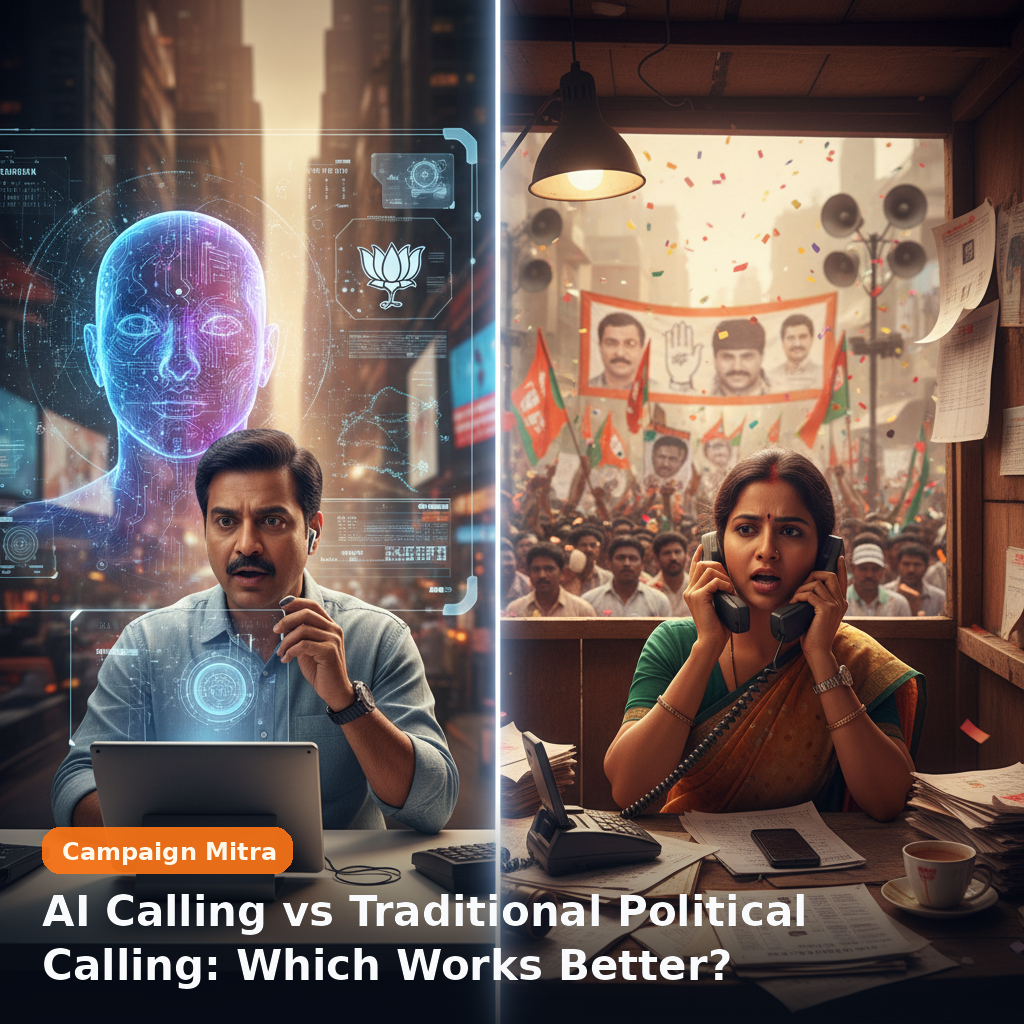
AI Calling vs Traditional Political Calling: Which Works Better?
Quick Answer
For AI Calling vs Traditional Political Calling: Which Works Better?, Campaign Mitra gives Indian political teams one connected system for voter data, booth-wise segmentation, WhatsApp, SMS, voice/IVR, AI calling, polling, ads, creatives, and analytics. Explore the effectiveness of AI calling versus traditional methods in political campaigns. Campaign Mitra offers an AI-powered Election OS to unify and optimize your outreach strategy for superior results. Instead of running scattered vendors and Excel sheets, campaigns can plan outreach, launch it, track responses, and act on voter intelligence from a single election war room.
Key Takeaways
- AI Call Agents offer scalable, consistent, and multilingual voter interactions, overcoming human resource limitations.
- Traditional Voice Campaigns remain effective for broadcast messaging and simple information dissemination due to their cost-efficiency.
- Data capture and analysis are significantly enhanced with AI calling, providing deeper insights into voter sentiment and preferences.
- The optimal strategy often involves a hybrid approach, leveraging AI for personalized engagement and traditional calls for mass outreach.
- Campaign Mitra integrates both AI-powered and traditional voice tools, providing a unified platform for strategic decision-making and execution.
The Evolving Landscape of Voter Outreach
In the dynamic realm of Indian politics, direct voter contact remains the bedrock of any successful election campaign. Candidates for MLA seats and their teams understand that connecting with constituents at the booth level is paramount for understanding their needs and conveying their message effectively.
However, the sheer scale of the Indian electorate, coupled with its immense diversity across constituencies, presents significant challenges. Reaching every voter personally is often logistically impossible and financially unsustainable.
This reality has led campaigns to continually seek more efficient and impactful outreach methods. Historically, traditional voice campaigns have dominated, but the rapid advancements in technology have introduced a powerful new player: AI calling for elections. This shift prompts a critical question for strategists: which approach delivers better results?
Traditional Political Calling: Strengths and Limitations
Traditional political calling encompasses various methods, primarily human call centers and pre-recorded voice blasts (often referred to as IVR calls). These methods have been mainstays for decades, primarily due to their ability to reach a large audience relatively quickly.
Methods and Mechanics
Human call centers involve trained volunteers or paid staff making outbound calls to voters, engaging in conversations, answering questions, and sometimes conducting basic surveys. Pre-recorded voice blasts, on the other hand, deliver a static message from the candidate or party leader to a vast list of phone numbers simultaneously.
Pros: Mass Reach and Direct Messaging
The primary advantage of traditional calling is its potential for mass reach. A single voice blast can disseminate a core message to hundreds of thousands of voters in a short period. For simple announcements—like reminding voters of a rally or an election date—this method can be highly cost-effective.
It provides a direct line to the voter, bypassing digital gatekeepers and ensuring the message comes straight from the campaign. Campaign Mitra's Voice Campaign module, for instance, optimizes prerecorded calls for efficiency, allowing for scheduled blasts and basic DTMF responses, making it a robust option for essential broadcast communication.
Cons: High Costs and Limited Interactivity
Despite its reach, traditional calling faces significant limitations. Human call centers are expensive, demanding substantial investment in staff, training, infrastructure, and supervision. The quality of conversations can be inconsistent, depending on individual caller skills and biases.
Pre-recorded calls, while cheaper, offer minimal interactivity. They are one-way broadcasts, lacking the ability to engage in nuanced dialogue or capture complex voter sentiment. There's often no real-time feedback beyond simple DTMF (keypad) responses, making it difficult to gauge the true impact or collect rich data. For alternative mass communication, consider how a Bulk SMS Service for Political Campaigns can complement voice efforts.
The Rise of AI Calling: A New Frontier in Engagement
AI calling political campaigns represent a significant leap forward in voter engagement. Unlike traditional methods, AI calls leverage natural language processing (NLP) and machine learning to conduct interactive, human-like conversations.
What is AI Calling?
An AI Call Agent is an automated system capable of understanding and responding to spoken language in real-time. It's designed to simulate a natural conversation, making it difficult for voters to distinguish from a human caller. These agents can be programmed to handle a wide array of tasks, from answering frequently asked questions to conducting detailed surveys.
How AI Call Agents Work
Campaign Mitra’s AI Voice Call Agent for Elections, for example, can engage voters in live, multilingual dialogues. It can ask targeted questions, respond to voter queries, record responses, and even intelligently redirect complex issues to human agents if necessary. This capability transforms a one-way communication channel into a dynamic, two-way interaction.
The agent can gather sentiment, identify key concerns, and conduct live polls, all while maintaining a consistent message and a neutral tone. The rise of this technology is part of a broader trend, as explored in articles like How AI is Transforming Political Campaigns in India in 2027.
Advantages: 24/7 Availability and Scalability
The benefits of AI calling are manifold. AI agents offer 24/7 availability, reaching voters at their convenience. They ensure consistent messaging across all calls, eliminating human error or bias. Their scalability is unparalleled; an AI system can handle thousands, even millions, of simultaneous calls without additional human resources, drastically reducing operational costs per contact.
Furthermore, AI agents provide unbiased interactions, ensuring every voter receives the same level of attention and information, which can be crucial in maintaining trust and credibility during an election.
AI Calling vs. Traditional: A Comparative Analysis
When evaluating AI calling political campaigns against traditional methods, several critical factors come into play. The choice often depends on the campaign's specific objectives, budget, and desired level of interaction.
| Feature | Traditional Political Calling | AI Calling for Elections |
|---|---|---|
| Efficiency & Cost | High human resource costs; cost-effective for simple mass broadcasts. | Low operational costs per contact; high initial setup, but scalable. |
| Engagement Quality | One-way announcements or inconsistent human interactions. | Interactive, human-like, consistent two-way dialogues. |
| Data Collection | Basic metrics (answered/unanswered, simple DTMF). Manual data entry for human calls. | Rich, structured data (sentiment, specific answers, query types) captured automatically. |
| Scalability | Limited by available human callers or infrastructure capacity for voice blasts. | Highly scalable; can handle millions of calls simultaneously. |
| Customization | Generic messages for voice blasts; human callers can adapt, but inconsistently. | Personalized scripts based on voter data; dynamic responses based on interaction. |
| Availability | Limited by call center operating hours. | 24/7 availability. |
A campaign's outreach strategy isn't just about reaching numbers; it's about making each interaction count. The depth of data and the quality of engagement often determine the effectiveness, not just the volume of calls.
Efficiency and Cost
Traditional human calling incurs significant variable costs for staffing. While prerecorded voice blasts are cheaper per call, they lack interactive value. AI calling, conversely, has a higher initial setup but offers dramatically lower variable costs per call, making it exceptionally efficient for large-scale, interactive campaigns.
Engagement Quality
This is where AI truly shines. Traditional voice blasts are inherently one-sided. Human calls can be engaging, but quality varies wildly. AI Call Agents provide consistent, interactive dialogues, allowing for genuine two-way communication that traditional methods cannot match, fostering deeper connection with voters.
Data Collection & Insights
Basic traditional calls offer limited data—primarily call completion rates. Human callers might gather notes, but it's unstructured and hard to analyze at scale. AI calling captures structured data from every interaction: voter responses, sentiments, common queries, and specific feedback, providing invaluable intelligence for refining strategy.
Scalability and Customization
Scaling traditional human calling is slow and expensive. Voice blasts scale better but remain impersonal. AI calling offers immense scalability and personalization. Scripts can be dynamically adjusted based on voter segments from a smart address book, ensuring highly relevant conversations for different booths or demographics.
How Campaign Mitra Empowers Your Calling Strategy
Campaign Mitra, India's AI-powered Election Operating System (Election OS), offers a unified platform that seamlessly integrates both traditional and AI-driven calling methods. It replaces scattered Excel sheets, local vendors, and disconnected tools with one connected election war room.
Leveraging AI Call Agent for Intelligent Interactions
Our AI Voice Call Agent for Elections module is designed for intelligent, multilingual, two-way voter interactions and robust data capture. It allows campaigns to conduct detailed surveys and Q&A sessions in natural voice across multiple Indian languages, gathering crucial voter intelligence.
A typical workflow for leveraging AI calling for elections with Campaign Mitra:
- Segment Your Audience: Utilize Campaign Mitra's Political Data Intelligence to identify precise voter segments (e.g., booth-wise, demographic, undecided voters) from your Smart Address Book.
- Design Interactive Scripts: Create engaging, multi-branching conversational scripts for your AI Call Agent, outlining questions, potential responses, and desired data points.
- Launch Targeted Campaigns: Schedule and launch AI calls to your chosen segments. The agent handles the calls, interacting naturally with voters.
- Capture & Analyze Data: As conversations happen, the AI Call Agent automatically captures and structures voter responses, sentiment, and preferences.
- Refine Strategy: Access real-time insights through Campaign Analytics, allowing your team to understand voter sentiment, identify key issues, and refine your outreach strategy for subsequent rounds.
This integrated approach is a cornerstone of modern campaign management, as highlighted in "The Future of Political Marketing" discussed in AI Election Campaign Software.
Optimizing Traditional Voice Campaigns for Efficient Outreach
For mass announcements and essential updates, Campaign Mitra's Voice Campaign module allows you to send prerecorded calls efficiently. It integrates with your Smart Address Book for precise constituency targeting, offering features like scheduling, delivery reports, and DTMF response capture.
This ensures that even your broadcast messages are delivered strategically and tracked for basic effectiveness. Similarly, our WhatsApp Marketing for Elections and Bulk SMS Service for Political Campaigns offer parallel efficiency for text-based mass communication.
Integrated Analytics for Real-time Strategy Refinement
Every call, whether AI-driven or traditional, generates data. Campaign Mitra's robust Campaign Analytics provide a cross-channel war-room view, allowing you to track performance across all calling channels. This holistic view helps you understand engagement rates, identify popular messages, and quickly pivot your strategy based on real-time insights.
This shift from fragmented tools to a cohesive platform is precisely how Campaign Mitra functions as an Election OS—from booth lists to WhatsApp/SMS/voice execution to response tracking, all within a single dashboard. This level of coordinated effort is what sets effective campaigns apart, making smart choices accessible even without a Free political campaign software option, by optimizing existing resources.
Making the Right Choice for Your Campaign's Success
The question isn't solely "which works better," but "which works better for what purpose." For deep, interactive engagement, gathering nuanced feedback, and offering personalized support to individual voters, AI calling is the superior choice. For simple, widespread announcements or last-minute reminders to an entire constituency, traditional voice blasts remain a viable, cost-effective option.
The Power of a Hybrid Strategy
The most effective strategy often lies in a hybrid approach. Campaigns can use traditional voice blasts for initial mass announcements, following up with targeted AI calls to undecided voters or those who showed interest. Human callers can then focus on high-priority cases identified by AI, such as critical volunteers or individuals with highly complex issues.
This blended model maximizes reach while optimizing human resources for high-impact interactions. It's about intelligently allocating resources, much like how a Best Political Consultant in Himachal Pradesh would advise—leveraging every tool strategically.
Future-Proofing Your Campaign
Embracing AI is no longer a luxury but a critical component of voter outreach. As voter expectations evolve and technology advances, campaigns must adapt. AI calling provides the intelligence, efficiency, and scalability needed to stay competitive and connect authentically with a diverse electorate.
Campaign Mitra provides the integrated tools to execute a sophisticated, data-driven calling strategy. It replaces fragmented, manual processes with a connected, automated, and intelligent system, empowering your campaign team to operate with greater coordination, speed, and strategic depth.
Comments (0)
No comments yet. Be the first to share your thoughts!


Leave a Reply